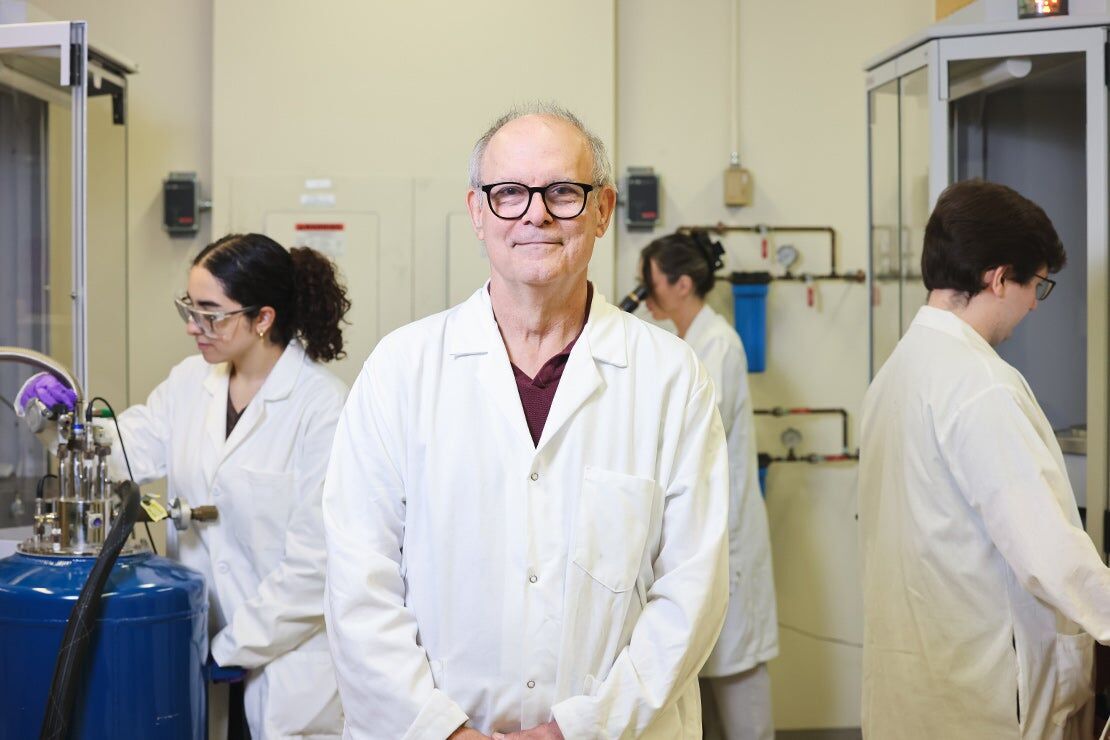
Doug Stephan, a University Professor in the department of chemistry in the Faculty of Arts & Science, has won the 2026 Davy Medal from the Royal Society in the U.K. The medal goes each year to an outstanding chemist and was first awarded in 1877.
It honours a discovery from 2006, the idea of “frustrated Lewis pairs,” or FLPs. For a century, Stephan explains, chemists leaned on rare, precious metals such as rhodium, platinum or palladium to speed up reactions. FLPs let them use common elements such as phosphorus, boron or nitrogen instead.
Why the metal matters
Stephan estimates that over 90 per cent of chemical products rely on a production process with at least one catalytic step. In drug making, he says, roughly 40 per cent of syntheses involve at least one hydrogenation, and 70 per cent of production cost can go to purifying away traces of toxic metals.
His everyday example is natural peanut butter. Adding hydrogen to the oil is what turns it into the semi-solid kind in the familiar brands.
I don’t think you do science for the awardsDoug Stephan
FLPs are not used commercially yet. Stephan says discoveries like this take decades to reach products, and he does not expect another 20 years. He points to Dow Chemical in Michigan, which is developing FLP reagents for silicon compounds used in sealants, lubricants and medical tubing.
He calls the medal the icing on the cake, and says the best part is seeing other chemists take the concept in directions he never thought of. Stephan became a Fellow of the Royal Society in 2013.
Reported from U of T chemist Doug Stephan awarded 2026 Davy Medal by the U.K.’s Royal Society (U of T News, August 27, 2026).
More from the original reporting: www.utoronto.ca/news/u-t-chemist-doug-stephan-awarded-2026-davy-medal-uk-s-royal-society